Waterfowl
Australian Shelduck
Tadorna tadornoides
Audio guide
Listen to the story of this animal
0:000:00
Australian Shelduck
- Description
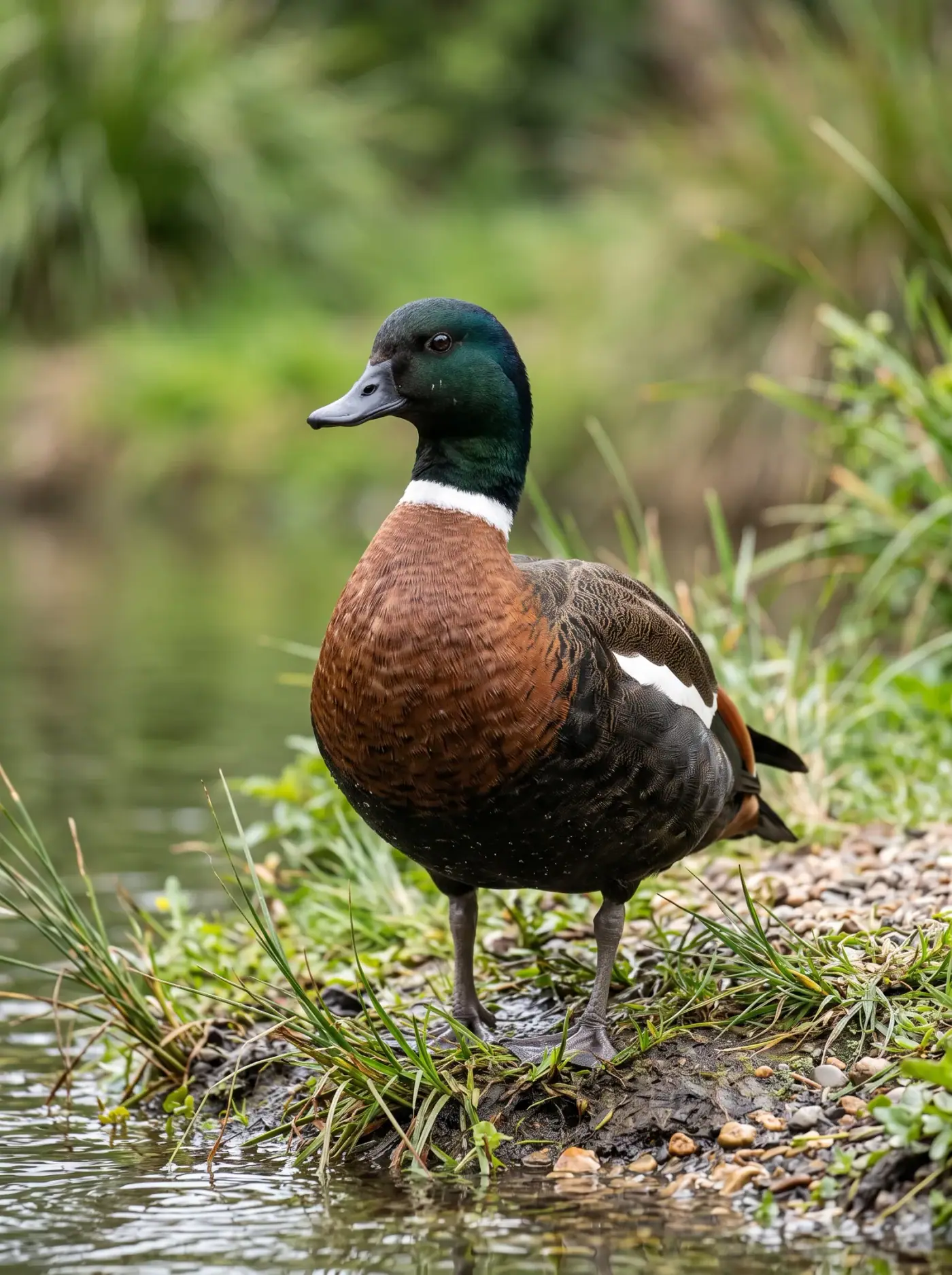
- The Australian shelduck is a large, goose-like duck with a small head and short bill, growing to about 56–72 cm and weighing around 1.3–1.6 kg, with drakes noticeably larger than hens. The male has a glossy dark-green head and neck set off by a white neck ring above a rich cinnamon breast, while the black wings flash a striking green speculum and chestnut shoulder feathers in flight. The female is similar but shows a boldly chestnut breast and a distinctive white ring around the base of the bill.
- Habitat
- It is native to southern Australia and Tasmania, favouring wetlands, lakes, swamps, pastures and open woodland. Birds gather in large flocks at traditional sites to moult and often move northward after breeding.
- Diet
- A versatile feeder, it grazes on land and dabbles and filters in shallow water, taking tubers and plants such as saltbush and samphire along with insects, crustaceans and molluscs.
- Reproduction
- Pairs are long-lasting and usually nest in tree hollows, sometimes up to about 20 m above the ground, or on the ground where cavities are scarce. The female alone incubates a clutch of roughly 10–14 eggs for about 30–32 days, and the ducklings become independent at around 50–70 days.
- Lifespan
- Australian shelducks first breed at about two years old and can live for many years, often reaching well over a decade in human care.
- Did you know?
- Its nickname 'mountain duck' belies its noisy nature: the drake gives a deep goose-like honk while the female answers with a high, penetrating 'zeek, zeek', and the young often gather into large communal crèches watched over by a few adults.
Homeland & habitat
Where the australian shelduck lives
Spin the globe to see where the species comes from and where it lives today.
Southern AustraliaEndemic to southern and south-western Australia and Tasmania, breeding near shallow lakes and wetlands, with occasional vagrants reaching New Zealand.
Loading globe…
Native range
Drag to rotate · double-click to recentre on the homeland
5 facts about the australian shelduck
The cards keep rotating — hover with your mouse to pause them.
- GroupWaterfowlvrubozobí (Anseriformes) · kachnovití (Anatidae)
- Scientific nameTadorna tadornoidesLatin name of the species
- ReproductionHusice australská tvoří dlouholeté, snad i trvalé páry. Do hnízdišť dolétá v březnu. V dubnu a květnu dochází k zabírání teritoria. zahnizďuje nejraději v dutinách stromu, často i kolem 20 metrů nad zemí. V případě nedostupnosti vhodných stromových dutin může zahnízdit i na zemi v králičích norách nebo v husté vegetaci. Vejce jsou kladena v denních intervalech, velikost snůšky se pohybuje mezi 10−14 vejci. Inkubuje pouze samice po dobu 30−32 dnů. K osamostatnění mláďat dochází kolem věku 50−70 dní. První zahnízdění nastává kolem věku 2 let.
- Where in the zooArea A — the water-lily pond
- How many we keep♂ 1 · ♀ 1total: 2
Support the care of our animals
A symbolic adoption contributes to feeding, veterinary care and the development of the exhibits — and you get a certificate and updates about your animal.
Browse adoptions